Get a free page

Your paper, explained to the public. Checked against the full text. Approved by you.

Send the DOI of your published health paper. Within 48 hours you get a plain-language page of it, free, checked line by line against the full text. Fix anything. Then decide if you want the video: $300 per paper until 31 December 2026, then $450. Any paper, old or new. Costable to your grant.

The page is free and stays online. Videos are paid, and you approve them before they go out.

The library is the proof

Every paper we have covered has a page like the one you would get: what was done, what was found, the catch, the citation, and how it was checked. Free to read, no sign-up. Open any one and compare it with the paper.

35 papers, one page each

For example exercise, physical jobs and dementia (The Lancet Public Health), light at night and the heart (European Heart Journal) and three diets and the liver (Cell Metabolism). Your page would sit next to them, labelled “made with the authors”.

Open the library

What you get

The page is free. The three video formats are paid and come from the same checked text, so one story works on social media, your lab website and in a press email. Here they are for one example paper.

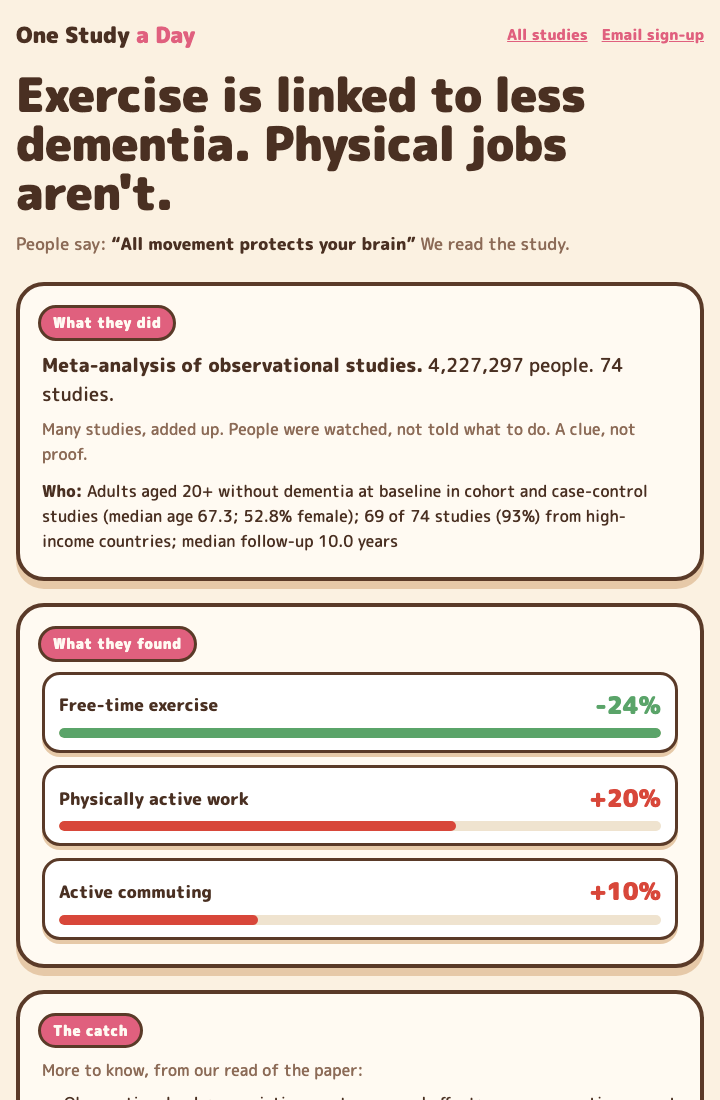
Example paper: Feter et al., “Domain-specific physical activity levels and risk of dementia: a systematic review and meta-analysis”, The Lancet Public Health, 2026. Meta-analysis of 74 observational studies, 4,227,297 people. doi.org/10.1016/S2468-2667(26)00142-8

Single and Paper pack 50-second vertical explainer For TikTok, Instagram Reels, YouTube Shorts and LinkedIn. Hook, what was done, what was found, the limits, and the link to the paper. Captions burned in.
16:9 versionNot yet made for this paper. Available on request.
On request 2-minute 16:9 version A longer cut for your lab website, YouTube, a conference slide or a press page. Room for the methods and the limits in full.
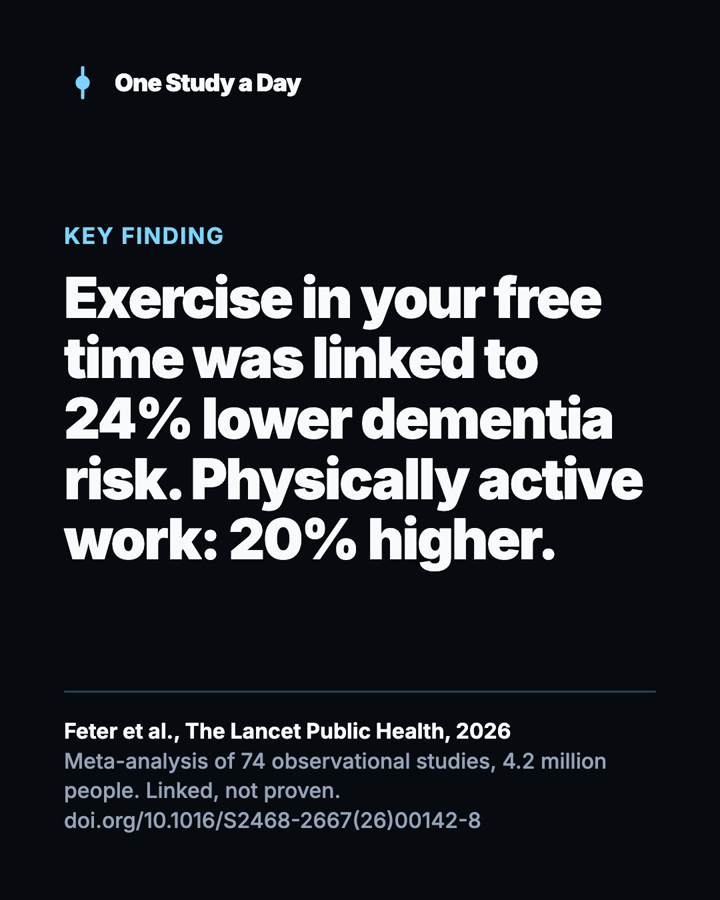
Quote card: Exercise in your free time was linked to 24% lower dementia risk. Physically active work: 20% higher. Feter et al., The Lancet Public Health, 2026.
Paper pack 15-second teaser and quote card The teaser is the opening of the explainer, cut to 15 seconds. The quote card is one finding with the citation, sized for LinkedIn, X and newsletters.
The plain-language page for the example paper
Free Plain-language page What they did, what they found, the catch, and the citation, in words a 12-year-old can follow. Hosted in the library, and yours to copy to your own site. Read this one

One script, five styles. Pick what fits your audience.

The same paper, the same checked numbers, the same narration. Only the look changes. Every one of these is the Feter 2026 dementia paper, so you can compare.

Clean Dark, full-screen footage Stock footage under a dark tint, white captions, the paper on a white card. Reads as news. Best for: the university's or journal's social accounts, your lab website.
Data first No footage. Numbers, cards, citation. The same dark look with the stock footage removed, so nothing on screen is decorative. The bars and the paper carry the frame. Best for: researchers who distrust b-roll, conference feeds, LinkedIn.
Warm Paper background, one sentence at a time Cream page, rounded type, footage in a framed window, each spoken sentence shown whole. Easier to follow for people who are not used to science. Best for: patient groups, community talks, a department's own accounts.
Sketch White paper, handwriting, marker outlines Looks drawn by hand on squared paper. No footage, no photos, nothing that could be mistaken for a stock image of a patient. Best for: teaching, slides, charities, anything where a photo would feel wrong.
Playful A cartoon cat reacts, the facts stay the same The warm style with a small cat in the corner that reacts to the findings. The script, the numbers and the limits do not change. Best for: schools, family audiences, public-health campaigns aimed at a general public.
Your lab's lookYour logo and colours, 16:9 for talks and websites. Made on request.
On request Your own colours, 16:9 Any style with your institution's logo and colours, and a 16:9 cut for a conference slide, a press page or a lab website. Part of the Lab plan, or as an add-on. Best for: a lab, centre or department that wants every paper to look the same.

The style never changes a fact. The script and the numbers are the same in every version, and every version is checked against the full text and approved by you.

Why labs do this

Five reasons, in researchers' own words. The numbers come from the Royal Society's 2025 survey of 1,149 UK researchers and the 2015 Wellcome Trust survey of 2,454.

“The work has implications for people. It should not stop at the PDF.”

Three in four UK researchers say sharing their findings and the benefit to society is why they engage with the public, and nine in ten say their work has implications beyond academia. This is the reason most people give, ahead of any career motive.

“I would do more of this if it took less of my time.”

Three in four researchers name time as the barrier, and the single thing most say would make them engage more is being relieved of the work. Here you send a DOI, answer two or three questions by email, and review a draft. The rest is ours.

“My funder already expects it.”

More than half of externally funded UK researchers say public engagement is part of their funding requirements, and 85% of those funded by NIHR. UKRI says engagement should be costed in proposals; US federal awards allow the cost of communicating results to the public. The exact wording.

“More people read the paper when there is a short, clear version.”

Studies of video abstracts and plain-language summaries link them to more views and more attention for the paper. Citation effects are smaller and uncertain, and we say so rather than promise them.

“If a short version of my paper is going to exist online, I want it to be the accurate one.”

Nine in ten scientists call the risk of being misquoted an important reason not to talk to the media, and half say oversimplified coverage is a major problem. Much of the exaggeration starts in press releases. Ours cannot leave your desk until you have signed it off.

How it works

No filming, no presenter, no meetings. One email from you, one round of corrections.

Send the DOI

Of your paper or report. A PDF works too if it is not open access.

We read, check and write the page

Abstract and full text. We write only what the paper says, name the study design and the limits, and send you the page within 48 hours. Free.

You correct and approve

Change anything. The page goes into the library only with your yes, labelled “made with the authors”.

Add the video if you want it

Script and fact table first, then the files and post texts sized for LinkedIn, X, Shorts and your newsletter, within 48 hours of your approval. Paid, see below.

Pricing

The plain-language page is free. Videos are priced per paper, in US dollars, so a principal investigator can buy them without procurement. You pay after you approve the script.

Single

$300
per paper, any paper of yours, old or new, until 31 December 2026. After that $450.
  • 50-second vertical explainer
  • Plain-language page
  • Post text with the citation and DOI
  • You see the script first, two rounds of changes
Most useful

Paper pack

$950
per paper
  • Everything in Single
  • 2-minute 16:9 version
  • 15-second teaser and quote card
  • Post texts for each platform

Lab plan

$1,600
per month, up to 3 papers a month · $400 for each extra paper
  • For a press office, trials unit or centre that wants every paper covered
  • Paper pack for each new paper
  • Monthly or quarterly schedule
  • Your logo and colours
  • Cancel any month

Need it in another language too? Add $150 per language per paper. Prices exclude VAT where it applies. We invoice in USD, GBP or EUR at the day's rate.

Need a lay summary anyway?

For some studies a plain-language summary is not optional. Our page can be that summary: checked against the full text, corrected by you, hosted, and yours to paste into a form.

Cost it in your grant

Telling the public what your funded research found is usually an allowable cost, not a marketing expense.

Under the US Uniform Guidance, 2 CFR 200.421 lists communicating with the public about the results of a federal award as an allowable public relations cost. UKRI expects public engagement to be planned and costed in proposals. Wellcome allows dissemination costs and the use of external suppliers for it. Your grants office can confirm what applies to your award, and we invoice in USD, GBP or EUR.

  • NIH and other US federal grants: 2 CFR 200.421(d)(2), communicating results of the award to the public.
  • UKRI: engagement and dissemination costed in the proposal.
  • Wellcome: dissemination and external supplier costs allowed.
  • Not legal or financial advice. Check the rules of your own award.

How we make sure you are never misquoted

The exaggeration in science news usually starts in a press release the scientist signed off in a hurry. These rules exist so that cannot happen here, and they are the same rules we use on our own channel every day.

We take no sponsors, and we do not make videos about a client's competitors.

Questions researchers ask

Send the DOI of your latest paper

You will have a free plain-language page within 48 hours. Correct it, approve it, and decide about the video later or never. Want to see the format first? Night light and the heart, activity and dementia, keto and the liver.